
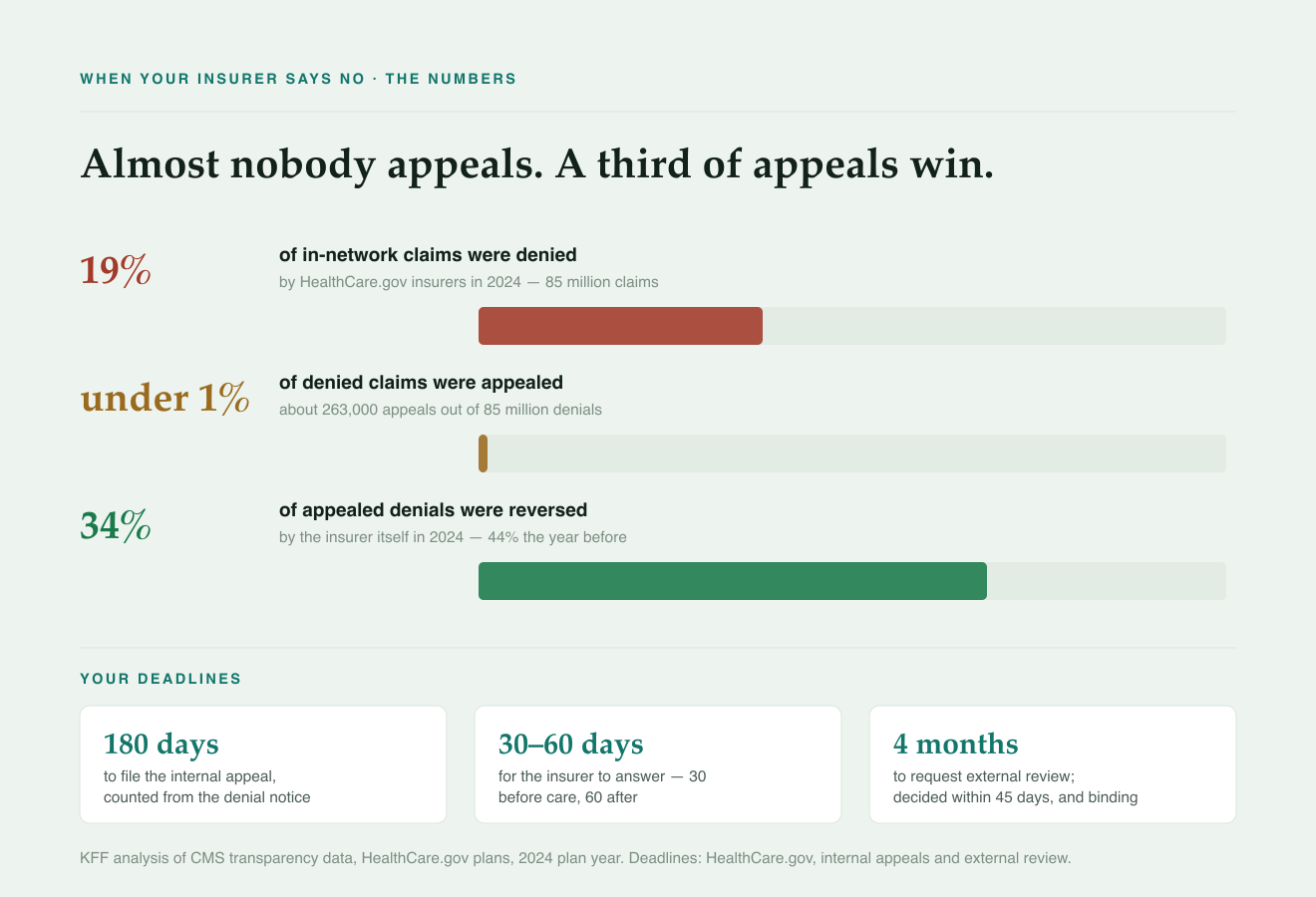
The letter says your claim was denied, and the letter is counting on what you do next: nothing. That is what almost everyone does. In 2024, insurers selling plans on HealthCare.gov denied about 85 million in-network claims — 19 percent of everything submitted — and consumers appealed fewer than 1 in 100 of them. The few who did appeal got the denial reversed about a third of the time, by the insurer itself, without a lawyer, without a court, without anything but a letter and a deadline. In 2023 the reversal rate was 44 percent. Those are odds nobody would walk away from at a casino, and nearly everybody walks away from them here.
Why "no" is so often not the real answer
Here is what the denial statistics quietly reveal. When federal regulators made insurers report the reasons for their denials, only about 5 percent were for "medical necessity" — the insurer's doctors disagreeing with your doctor. About 25 percent were administrative problems, 13 percent were services the plan says it excludes, 9 percent were a missing prior authorization or referral, and a full 36 percent were listed as "other," which is not a medical judgment either.
Read that again from your side of the table: the great majority of denials are not the insurer saying "you did not need this care." They are a wrong billing code, a form that did not arrive, a referral that was not attached, a box left unticked. Paperwork denials die when someone corrects the paperwork — and insurers know most people never will.
One more thing worth knowing: a surprising number of denials are simple coding errors by the clinic or hospital, and those do not even need an appeal. The billing office can correct the code and resubmit the claim. That is why the first phone call below goes to your doctor's office, not the insurer.
What to do, starting today
- Find the reason. The denial letter and your explanation of benefits carry a reason code. If it reads like fog, call the insurer — the member number is on your card — and say: "Please tell me the exact reason this claim was denied, and what document would change the outcome." They are required to tell you.
- Call your doctor's billing office next. Say the claim was denied and read them the reason. If it is a coding or filing error, ask them to correct and resubmit — done, no appeal needed. If the insurer wants justification, ask the office for a letter of medical necessity. Doctors write these routinely; it is normal to ask.
- File the internal appeal in writing. You have 180 days from the denial notice. Keep it plain: your name, member ID, claim number, the words "I am appealing this denial," why the care was needed, and the doctor's letter attached. Send it the way the denial letter instructs, and keep a copy of everything with dates.
- Know their clock. The insurer must decide within 30 days if you have not received the care yet, 60 days if you already have. If waiting would endanger your health, say so and ask for an expedited appeal — there is a faster track.
- If they uphold the denial, ask for external review. An independent reviewer with no stake in the answer looks at the case. You usually have 4 months to request it, a standard review is decided within 45 days, and the decision binds the insurer. The final denial letter must tell you how to file. Hardly anyone uses this step — about 4 percent of upheld appeals went to external review in 2024 — and it exists precisely for you.
This applies to most private insurance — through work or the marketplace. Medicare and Medicaid have their own appeal routes with their own deadlines, but the same principle: the first no is the start of a process, not the end of one.
And one honest tip from the physician's side of the desk: your doctor wants that claim paid too — an unpaid claim usually becomes either their unpaid bill or yours. Ask the billing office for help and you will mostly find an ally who fights these letters all day. The system's arithmetic depends on the 99 people who never write back. The appeal exists for the one who does — and a third of the time, that one letter erases the bill.
Sources
- KFF — Claims Denials and Appeals in ACA Marketplace Plans in 2024. kff.org/patient-consumer-protections/claims-denials-and-appeals-in-aca-marketplace-plans-in-2024
- KFF — Claims Denials and Appeals in ACA Marketplace Plans in 2023. kff.org/private-insurance/claims-denials-and-appeals-in-aca-marketplace-plans-in-2023
- HealthCare.gov — Internal appeals. healthcare.gov/appeal-insurance-company-decision/internal-appeals
- HealthCare.gov — External review. healthcare.gov/appeal-insurance-company-decision/external-review