
Getting your own medical records should be dull. In practice it is one of the most reliably frustrating things a patient does, and the frustration is usually manufactured by a records department that knows the rules better than you do.
Here is what the rules actually say.
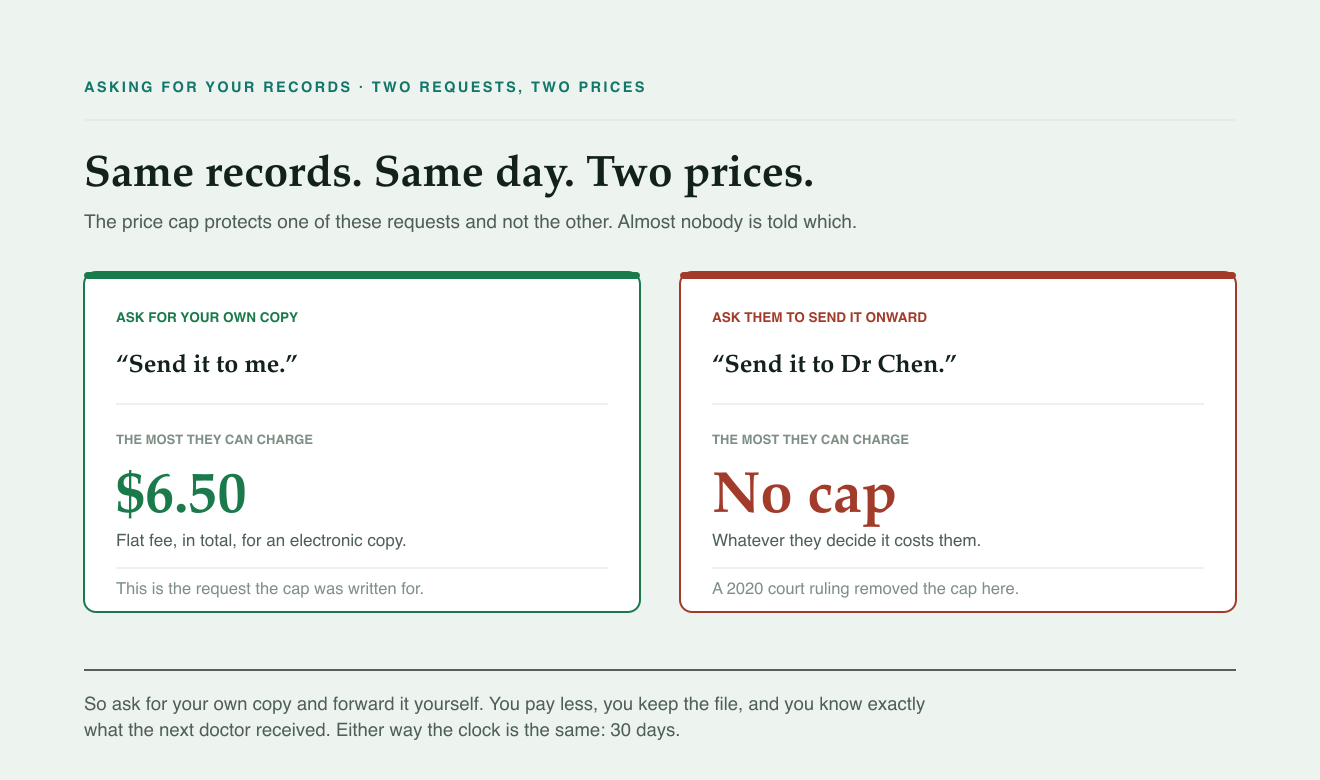
The request costs $6.50. The other request does not.
There are two different things you can ask for, they sound almost identical, and only one of them is protected by a price cap.
"Please send me a copy of my records." This is a request for access to your own information. The provider may only charge a reasonable fee based on what it actually costs them. If your records are kept electronically and you want an electronic copy, they are allowed to skip the arithmetic and charge a flat fee instead — and that flat fee cannot be more than $6.50 in total.
"Please send my records to Dr Chen." This sounds like the same thing with a delivery address attached. Legally it is not. In January 2020 a federal court struck down the part of the rule that applied the price cap to records sent onward to a third party, in a case called Ciox Health v. Azar. For that request, the cap no longer applies.
So the practical advice is almost embarrassingly simple: ask for your own copy, then forward it yourself. You will pay less, you will have the file, and you will know exactly what the next doctor received — which matters more often than people expect.
There is one clean exception worth knowing. If both offices use patient portals or an electronic records network, a doctor-to-doctor transfer is usually free and instant, and none of this applies. Ask whether they can send it electronically before you pay for anything.
The clock is 30 days
They have 30 calendar days from your request. They may take one extension of another 30 days, but only if they tell you in writing, within the first 30, why they need it.
That is the outside limit, not the normal wait. Most electronic records can be released in days. If someone tells you six to eight weeks as though it were policy, the honest reply is that the rule says thirty days.
Two more things they cannot do:
They cannot make you say why. You do not have to explain what the records are for, and being asked is not a reason to answer.
They cannot hold your records because you owe them money. An unpaid bill is a separate argument. It is not grounds to withhold your record.
How to ask
Put it in writing — email is fine, and a paper trail is the point.
- Say what you want. "A complete copy of my medical records" is fine. If you only need part of it — say, imaging reports from the last two years, or the operative note — ask for that instead. It is faster and cheaper.
- Say what format you want, and ask for electronic if the records are electronic. That is what makes the $6.50 flat fee available.
- Ask for the fee in advance. You are entitled to know what it will cost before it is done.
- Ask for it to come to you, not to a third party, for the reason above.
- Note the date you asked. That is day one of the thirty.
When they stall
Ask for the name of the privacy officer. Every practice and hospital has one, and most stalling stops at the point where you use the phrase "HIPAA right of access" to a person whose job title contains the word privacy.
If that does not work, you can file a complaint with the HHS Office for Civil Rights. It is free, it is done online, and it does not require a lawyer. Records access has been a specific enforcement priority for that office, and providers know it.
One last thing, and it is the reason to do this before you need it: the moment you actually want your records is almost always the moment you have the least patience for a thirty-day wait — a new diagnosis, a second opinion, a surgeon in another city with an opening next week. A copy sitting on your own drive costs $6.50 and one email today.
Sources
- HHS — Individuals' right under HIPAA to access their health information. hhs.gov/hipaa/for-professionals/privacy/guidance/access
- HHS — Filing a HIPAA complaint. hhs.gov/hipaa/filing-a-complaint
- Quarles — Ciox case changes the HIPAA rules on patient rate caps for access to health records. quarles.com/publications
- Dinsmore & Shohl — Federal court strikes down HIPAA fee limitations for third-party medical records requests. dinsmore.com/publications