
Here is the bill this article erases. You went to an in-network hospital — you checked, you did everything right. Weeks later an envelope arrives from a doctor you never met and certainly never chose: the anesthesiologist, the radiologist who read your scan, the pathologist who looked at your biopsy, the assistant surgeon you did not know was in the room. The bill says your insurance paid some of it and you owe the out-of-network rest — hundreds or thousands of dollars. Before 2022, that bill was legal and common: about 1 in 5 emergency visits ended with an out-of-network charge. Since January 1, 2022, under a federal law called the No Surprises Act, that bill is usually not legal at all. And most people have never heard of it — in KFF's polling, 78 percent of the public knew little or nothing about the law.
What the law protects, and the one big gap
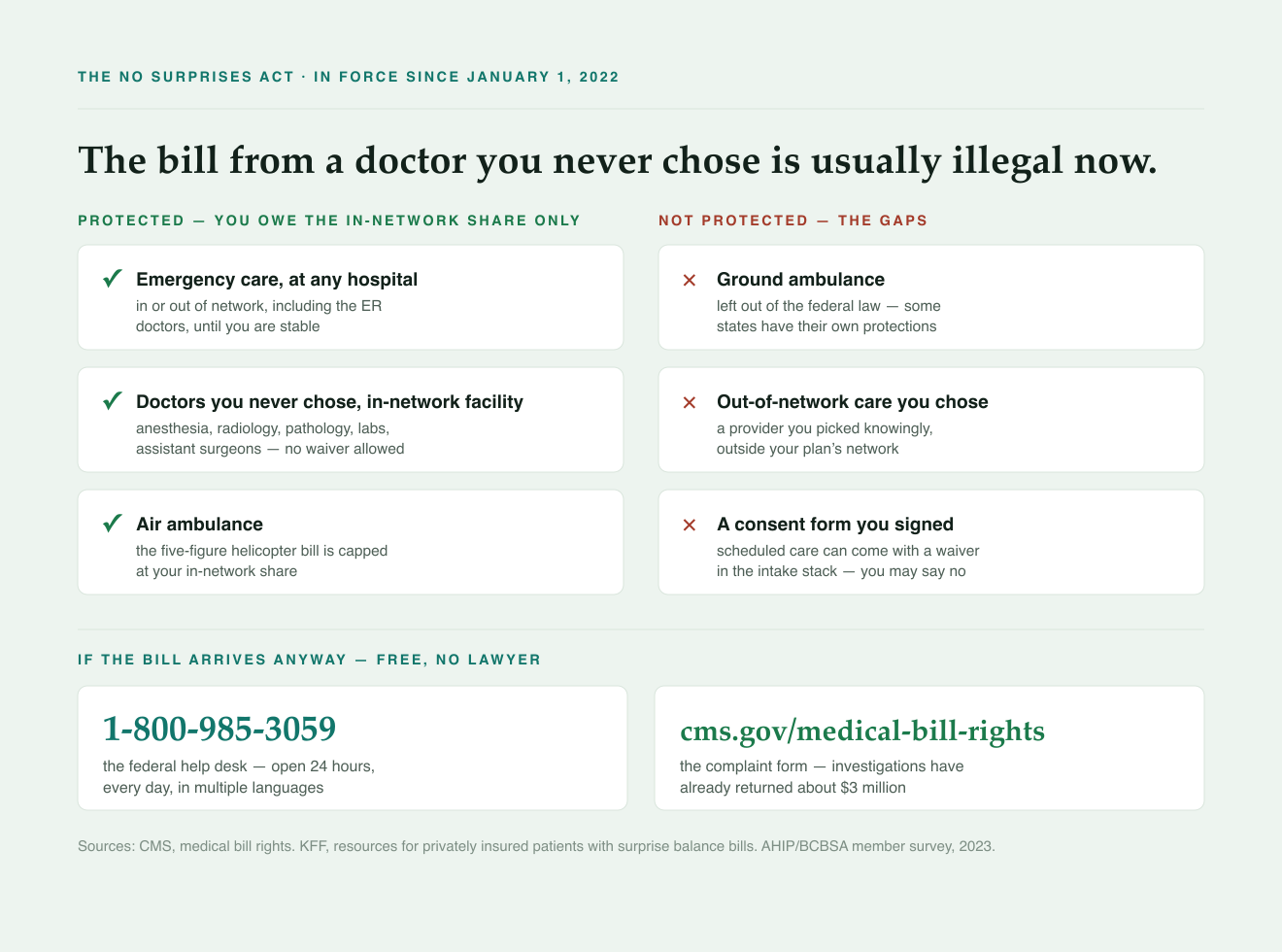
The protection covers three situations, and in all three you owe only what you would have paid in network — the deductible, copay or coinsurance shown on your plan's explanation of benefits — no matter what the doctor's bill says:
- Emergency care, at any hospital. In network, out of network, it does not matter. This includes the ER doctors, and it includes most care after you arrive until you are stable.
- Out-of-network doctors at an in-network hospital or surgery center. Anesthesiologists, radiologists, pathologists, labs, neonatologists, assistant surgeons — the people you never chose. These specialties cannot even ask you to sign the protection away.
- Air ambulances. The famous five-figure helicopter bills are capped at your in-network share.
Two honest warnings from the doctor's side of the desk. First, ground ambulances are not covered — Congress left them out, so the ride itself can still generate a real balance bill unless your state has its own law. Second, for care you schedule yourself with an out-of-network provider, the office can hand you a consent form that waives the protection — it is usually in the intake stack, and you are allowed to say no and ask for an in-network provider instead.
The bill still arrives sometimes. Here is what to do.
The law works — insurer groups counted more than 10 million surprise bills prevented in the first nine months of 2023. But billing offices make mistakes, some chance it, and a wrongly processed claim can dress an illegal bill up as a legal one. The law defends the person who recognizes the bill:
- Do not pay it on sight. Find the explanation of benefits for that visit — your insurer's app or portal has it. For protected care, the line that says what you owe is your entire obligation.
- If the doctor's bill is bigger, call their billing office and use the law's name: "This looks like a balance bill for protected care under the No Surprises Act. Please rebill me for my in-network share." Named correctly, many of these bills simply disappear.
- Call the federal help desk: 1-800-985-3059. It is free, staffed 24 hours a day, and exists to tell you whether your bill is covered and what to do next.
- File the complaint at cms.gov/medical-bill-rights. It takes minutes, costs nothing, needs no lawyer, and the government investigates — by late 2023, complaint investigations had already forced about $3 million back to patients and providers.
- If your insurer processed the claim as out-of-network by mistake, appeal it — you have 180 days from the decision, and the denial letter must tell you how.
One more thing worth knowing: while a bill is in dispute, ask the provider in writing to pause collections — most will while a federal complaint is open. The old advice for surprise bills was to negotiate, beg, or pay in installments. That era ended in 2022. For the care this law covers, the correct amount is printed on your EOB, the enforcement line is free and open all night, and the bill from the doctor you never chose is no longer your problem to bargain over — it is theirs to explain.
Sources
- CMS — Know your rights: surprise medical bills. cms.gov/medical-bill-rights
- KFF — What resources are available for privately insured patients who get surprise balance bills. kff.org/health-costs/what-resources-are-available-for-privately-insured-patients-who-get-surprise-balance-bills
- AHIP and BCBSA — Survey: No Surprises Act prevented more than 10 million surprise bills in the first nine months of 2023. ahip.org/news/press-releases/new-survey-shows-no-surprises-act-continues-to-protect-millions-of-americans-from-surprise-medical-bills
- Peterson-KFF Health System Tracker — An examination of surprise medical bills. healthsystemtracker.org/brief/an-examination-of-surprise-medical-bills-and-proposals-to-protect-consumers-from-them-3